Looking forward versus looking back
A Pale View of HillsLooking forward versus looking back is a recurring tension in Etsuko’s recollections, joining postwar renewal to the private effort to live with loss. The language of optimism promises a future beyond wartime destruction, but it also appears when painful personal history is being set aside. Its force lies in that double use: moving forward can express hope, yet the insistence that the past should not be revisited can make a settled account sound less secure than it claims to be.
An injunction to carry on
Mrs. Fujiwara gives the idea its clearest early formulation when she tells Etsuko that the painful experience she once endured belongs to the past and that she managed to carry on. The encouragement makes endurance sound both possible and expected: grief need not determine the rest of a life. Etsuko answers by recalling how kind Ogata-San was to her, acknowledging that her ability to continue was not simply a matter of will. In her account, another person’s care helped her through a period of heartbreak. The exchange therefore qualifies the appeal to self-reliance; moving on may depend on support as well as determination.
Mrs. Fujiwara later turns the same future-facing language into a question about Etsuko’s present state. She reminds the pregnant Etsuko to eat regularly, then observes that she has everything to look forward to and asks why she seems unhappy. Etsuko denies being unhappy, but Mrs. Fujiwara continues watching her, and Etsuko laughs nervously. The brief response leaves a gap between the future others can see for her and the feeling she is prepared to acknowledge. Looking forward is not presented as a simple cure for distress: even amid a conversation about care and expectation, Etsuko’s reassurance does not dispel Mrs. Fujiwara’s concern.
A landscape remade
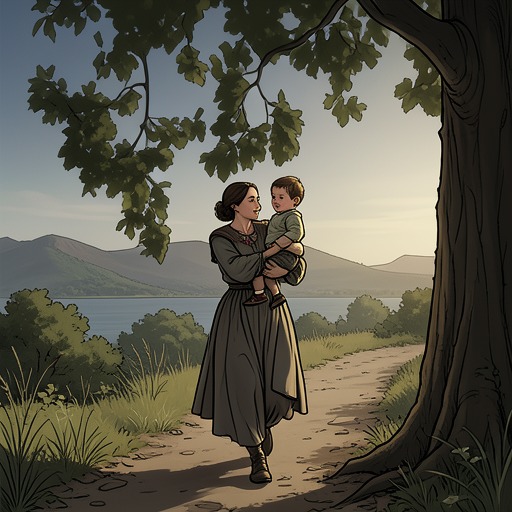
The tension becomes collective and visible when Etsuko and Sachiko look out over Nagasaki from a mountain. Below them, the harbor and the built-up land at the foot of the hills appear full of life. Etsuko contrasts that view with the area’s devastation when the bomb fell, then draws attention to what can be seen in the present: “look at it now”. The view places destruction and recovery within one frame. The rebuilt landscape gives her optimism a concrete basis; the city’s return to life is evidence that loss need not be the final condition of a place.
Etsuko explicitly turns that visible recovery into an argument for looking ahead. She says she has decided to be optimistic and recalls Mrs. Fujiwara’s advice to keep looking forward. In her formulation, without that orientation, the devastated area would still be rubble. The statement gives the landscape more than illustrative force: reconstruction becomes a model for the possibility of a future after catastrophe. Yet the scene does not erase what happened. The renewed city matters precisely because Etsuko and Sachiko can hold its present life beside knowledge of the bomb’s destruction. The forward gaze depends on memory of the ruins, even as it resists remaining fixed on them.
Motherhood and the imagined future
The conversation on the mountain also makes the future intensely personal. Etsuko, who is about to have a child, says that in the last few days she has begun thinking about what motherhood will be like and feels less afraid. Her decision to be optimistic is thus tied not only to the city’s recovery but to the prospect of starting a family. Sachiko affirms that hope by telling her that motherhood makes life worthwhile. She also explains her own priorities: despite the prospect of a dull life at her uncle’s house, she wants what is best for her daughter and plans to secure private tuition so the girl can catch up at school.
Sachiko’s hope is not a claim that the war left her untouched. She says that it destroyed many things for her, but that she still has her daughter; her future-facing outlook rests on what remains as well as what may come. Etsuko responds that both women have lost much but still have much to anticipate. Their repeated agreement gives the scene a rhythm of mutual reassurance, while the different circumstances beneath it remain distinct: Etsuko faces impending motherhood, and Sachiko describes responsibility for a daughter she already has. Looking forward here is neither an abstract slogan nor a denial of loss. It is a way these two women make their hopes legible through the relationships and responsibilities that shape their futures.
Refusal, memory, and uncertainty
Elsewhere, Etsuko’s appeal to moving on takes a more guarded form. Reflecting on her decision to leave Japan with Keiko, she insists that her motives were justifiable and that she kept Keiko’s interests at heart. She then says there is nothing to gain by going over the matter again. This is not the same kind of hope as the prospect of a child or the sight of a rebuilt city. It is a defense of a past decision coupled with a refusal to reconsider it. The language of putting the past behind oneself can protect a person from fruitless rumination, but here it also closes off inquiry into an emotionally consequential choice.
That refusal gives the concept its unresolved edge. Etsuko can describe the value of looking ahead in confident terms, and she can point to recovery around her; she can also be uneasy when another person notices that she may not be happy, and firm when asked, by implication, to revisit her past. These moments do not prove that her stated reasons are false. They do show that conviction and discomfort coexist, and that the instruction to move forward may serve different needs in different conversations. The novel places public recovery, maternal hope, and personal self-justification beside one another without making them equivalent. Looking forward offers a means of continuing after loss, while looking back remains necessary to understand what that continuation has required.